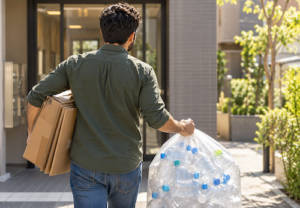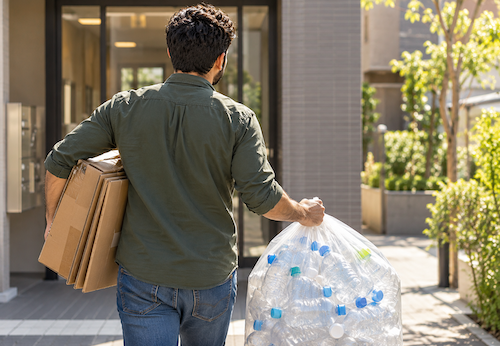
For new residents of Toyota City, Aichi
Recycling Stations in Toyota City
Where to take your PET bottles, cans, paper and more – free of charge, almost any day of the week. This page explains how the system works, what catches newcomers off guard, and which stations are open right now.
Back home vs. here in Toyota
Every country handles bottles and paper differently. Find the system you are used to and see what changes in Toyota City.
“Everything recyclable goes into one bin.”
Common in much of North America and Australia: bottles, cans and paper are mixed together and sorted later at a plant.
In Toyota: you do the sorting yourself. Each material has its own box or container, and paper alone is split into five kinds.
“I return bottles to the shop and get a deposit back.”
Deposit-return systems are used in Germany, the Nordic countries and elsewhere.
In Toyota: there is no deposit. You bring bottles to a recycling station (or put them out on collection day) and get nothing back – but it costs nothing either.
“Collectors or scrap buyers pick up bottles and cardboard.”
In many places, for example parts of Brazil, Southeast Asia and South Asia, informal collectors take valuable recyclables.
In Toyota: nobody comes to buy them. You take them to the city’s collection points yourself, cleaned and sorted.
“All rubbish goes into one bag.”
Some cities collect household waste without any separation.
In Toyota: household waste is divided into about ten categories. Recyclables must never go in with burnable garbage.
Why most people use recycling stations
- They are open almost every day.Most stations are open daily from 10:00 to 18:00, so you can drop things off on your way to the supermarket.
- You don’t need to know your collection calendar.The collection point near your apartment only takes recyclables on certain days, which differ by neighbourhood and can be hard to find out. Missing a day can mean waiting weeks.
- It is free.No fee and no special city garbage bag is needed. Just bring your sorted items.
- Many stations are at supermarkets.Several are in shop car parks, so recycling fits into a normal errand.
How to prepare items at home
Signs at the stations are mostly in Japanese, so the Japanese name is shown next to each item. Tap an item to open it.
PET bottlesペットボトル
- Remove the cap and peel off the label. The plastic ring at the neck can stay.
- Rinse the inside lightly with water, then let it dry.
- Crush it flat.
- Put the cap and label in the plastic packaging box, not with the bottles.
Not accepted as PET: bottles that are cut, painted or taped (these are burnable garbage), and shampoo or detergent bottles (these are plastic packaging). Look for the PET mark on the bottle.
Drink cans飲料缶
- Aluminium and steel drink cans only. Empty and rinse them.
- Aluminium and steel usually go into separate containers – check the labels アルミ (aluminium) and スチール (steel).
Not accepted: food tins and pet food cans, and metal screw caps from bottle-shaped cans. These are “metal garbage” (金属ごみ) on collection day.
Glass bottlesガラスびん
- Remove the cap, empty the bottle and rinse it lightly.
- Labels may stay on.
- Plastic caps go to plastic packaging; metal caps are metal garbage.
Not accepted: broken glass, drinking glasses, and milky-white cosmetic jars. Some stations do not take glass at all – check the station list.
Paper古紙類
Paper is sorted into five kinds. Keep each kind separate.
Tie bundles with paper string or carry them in a paper bag. Keep paper dry.
Not accepted: receipts and fax paper (heat-sensitive), paper cups, laminated or waxed paper, photos, stickers, shredded paper, paper smelling of soap or detergent, cartons lined with silver, and plastic (vinyl) string. Put these in burnable garbage.
Clothes & fabric古布類
- Clean, dry clothing and fabric. Bring them in a bag and keep them out of the rain.
Plastic packaging & food traysプラスチック製容器包装・食品トレイ
- Packaging with the プラ mark: snack bags, cup noodle containers, bottle caps and labels, vegetable nets, bento boxes, natto cups.
- Empty them completely and rinse off food.
- Foam food trays go into their own box (食品トレイ).
Not accepted: plastic products that are not packaging (toys, cases, buckets), and the city’s own garbage bags. Some stations do not take plastic – check the list.
Hazardous & dangerous items有害ごみ・危険ごみ
- Hazardous (有害ごみ): batteries, fluorescent tubes, mercury blood-pressure monitors.
- Dangerous (危険ごみ): lighters, spray cans, gas cartridges for portable stoves. Use them up completely first. You do not need to punch holes in spray cans.
Used cooking oil廃食用油
- Let the oil cool, pour it into any PET bottle, close it, and place the bottle in the basket provided.
- Only 10 stations accept oil – they are marked “+ Cooking oil” in the list below.
Things that often surprise newcomers
- “Clean” really means clean and dry.A quick rinse is enough, but bottles with drink left inside or wet, dirty paper make whole batches impossible to recycle.
- The bottle, cap and label are three different things.The bottle goes to PET; the cap and label go to plastic packaging. This is the most common mistake.
- Take your bags home.City garbage bags and plastic string are not accepted at the station. Empty your items into the right boxes and take the bag and string back with you.
- Paper is not just “paper”.Newspaper, magazines, mixed paper, cardboard and cartons all go separately. Receipts are not recyclable paper.
- Not every station takes everything.Some do not accept glass, plastic packaging or cooking oil. Check the list before you go.
- Mountain-area stations open only on some days.Obara, Asahi and Inabu open on weekends only; Onuma (Shimoyama) on Wednesday and weekends. All stations close over New Year.
- Household items only.Waste from shops or businesses is not accepted (except business paper at Togari-cho).
- Burnable garbage and large items are not taken here.Kitchen waste, broken furniture and appliances follow different rules. Ask the city office or use the city’s sorting app.
- Reading the signs.Use your phone camera with a translation app to read container labels. Staff may be present at larger stations – it is fine to ask.
Station list
Stations are grouped by area and listed in alphabetical order. Tap an address to open it in Google Maps.
No stations are open right now. Most stations open daily from 10:00 to 18:00.