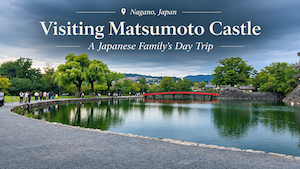
Exploring one of Japan’s most beautiful historic castles during a September holiday
During the September holidays, my family took a trip to Matsumoto and Tateshina in Nagano Prefecture, Japan.
We live in Toyota City, Aichi Prefecture, and we enjoy traveling to different parts of Japan whenever we have the opportunity.
One of the highlights of this trip was visiting Matsumoto Castle with our children and a family of friends.
Even though I am Japanese, there are still so many places in Japan that I have never visited and so much history that I have yet to discover.
This trip reminded me how enjoyable it can be to explore Japan’s history together with family and friends.
Threadsで見る
Matsumoto Castle: A National Treasure of Japan
Matsumoto Castle (松本城, Matsumoto-jō) is located in Matsumoto City, Nagano Prefecture.
It is one of Japan’s five castles designated as National Treasures.
Its black wooden exterior, white walls, and elegant roofs make it one of the most recognizable castles in Japan.
The castle is surrounded by a moat, and on a clear day, its beautiful reflection can be seen in the water. The mountains of the Japanese Alps provide a wonderful backdrop.
Matsumoto Castle is sometimes called the “Crow Castle” because of its striking black appearance.
Unlike many Japanese castles that have been reconstructed using modern materials, Matsumoto Castle still has its original wooden main keep, built more than 400 years ago.
A Little History: Why Was Matsumoto Castle Built?
To understand Matsumoto Castle, it helps to know a little about Japanese history.
Japan’s Age of Samurai and Warlords
During the 15th and 16th centuries, Japan experienced a long period of civil wars known as the Sengoku period, or the Warring States period.
At that time, Japan was divided into territories controlled by powerful military leaders called daimyo.
These leaders employed samurai warriors to protect their land and fight their enemies.
Castles were not simply beautiful buildings. They were military fortresses, important defensive positions, and symbols of political power.
The Construction of Matsumoto Castle
The site originally had a fortress called Fukashi Castle, built in the early 1500s.
In 1582, it was renamed Matsumoto Castle.
The main castle keep was constructed around 1593–1594 by the Ishikawa family, who governed the area under the authority of Toyotomi Hideyoshi, one of the most influential figures in Japanese history.
The impressive wooden structure has five visible levels from the outside but actually contains six floors inside.
It is the oldest surviving Japanese castle keep of this five-tiered, six-floor type.
A Castle That Survived for Centuries
In 1603, Japan entered the Edo period, an era of relative peace that lasted for more than 250 years.
As warfare became less common, castles gradually changed from military fortresses into administrative centers and symbols of authority.
In the 1630s, a beautiful moon-viewing tower was added to Matsumoto Castle.
This is one of the castle’s fascinating features: some parts were designed for war, while others were created during a more peaceful period.
In the late 19th century, after Japan’s feudal system ended, many castles were demolished.
Matsumoto Castle also faced the danger of being destroyed.
However, local residents worked to preserve the castle, allowing future generations to enjoy this remarkable piece of Japanese history.
Today, it is protected as a National Treasure.
Exploring the Castle with Family and Friends
For me, one of the greatest pleasures of traveling in Japan is sharing these experiences with my family.
This time, we explored Matsumoto Castle together with our friends and their children.
A historic castle is a wonderful place for children to discover that the history they learn about in books is connected to real buildings and real places.
Standing in front of a castle that has survived for more than 400 years makes Japanese history feel much closer.
And what makes the experience even more special is being able to enjoy it together.
Our trip was not only about visiting a famous tourist attraction. It was also about spending time together, making memories, and discovering another part of Japan.
What Makes Matsumoto Castle Special?
There are several features that make Matsumoto Castle particularly interesting.
1. The original wooden structure
You can enter the historic keep and see the wooden pillars, floors, and architectural features that have survived for centuries.
2. The steep staircases
The stairs inside the castle are surprisingly narrow and steep.
Some reach an angle of approximately 61 degrees!
Visitors need to climb carefully, especially when traveling with children or older family members.
3. The view from the upper floors
From the castle’s upper levels, visitors can look out over Matsumoto City and the surrounding mountains.
4. The impressive black exterior
The contrast between the black walls, white details, and surrounding water makes Matsumoto Castle particularly photogenic.
5. A chance to experience Japanese history
Rather than simply looking at a castle from the outside, visitors can explore the interior and imagine how the building was used centuries ago.
Matsumoto and Tateshina: A September Family Holiday
Our September trip also included Tateshina, another beautiful area in Nagano Prefecture.
Nagano is known for its mountains, natural landscapes, and historic towns.
For families who live in urban or suburban areas, visiting the mountains can provide a refreshing change of scenery.
Combining Matsumoto and Tateshina gave us the opportunity to enjoy both Japanese history and the natural beauty of Nagano.
Threadsで見る
A Japanese Mom’s Perspective
I was born and raised in the Tokyo area and have lived in Toyota City for many years.
Traveling to different regions of Japan reminds me that the country has much more variety than people sometimes imagine.
Each region has its own history, landscapes, traditions, and local culture.
Matsumoto Castle is a good example.
The castle is not simply a tourist attraction. It is part of the local community’s history and identity.
I also find it meaningful that the castle was preserved thanks to the efforts of local people.
As someone who now feels connected to my own community in Toyota City, I appreciate how important local history can be to the people who live there.
Traveling helps me discover other places, but it also gives me a new perspective on the place I call home.
Matsumoto Castle Visitor Information
| Information | Details |
|---|---|
| Name | Matsumoto Castle (松本城) |
| Location | Matsumoto City, Nagano Prefecture, Japan |
| Address | 4-1 Marunouchi, Matsumoto, Nagano 390-0873 |
| Opening hours | 8:30 a.m. – 5:00 p.m. |
| Last admission | 4:30 p.m. |
| Closed | December 29–31 |
| Adult admission | ¥1,200 online / ¥1,300 at the ticket office |
| Children aged 6–15 | ¥400 |
| Children aged 5 and under | Free |
| Recommended visit duration | Approximately 45–60 minutes inside the keep, plus time for the grounds |
| Accessibility | No elevator inside the historic keep |
| Website | https://www.matsumoto-castle.jp/eng |
Information checked in November 2026. Opening hours and fees may change, especially during holiday periods.
How to Get to Matsumoto Castle
By train: Matsumoto Castle is approximately a 15-minute walk from JR Matsumoto Station. Local buses are also available.
From Nagoya: The JR Limited Express Shinano connects Nagoya Station with Matsumoto Station in approximately two hours.
By car: Matsumoto is accessible by expressway from Aichi and other parts of central Japan. Visitors arriving by car can use public parking facilities around the castle.
Tips for Families Visiting Matsumoto Castle
- Wear comfortable shoes and socks, as visitors must remove their shoes before entering the castle keep.
- Be careful on the narrow, steep wooden staircases.
- Allow extra time during weekends and Japanese national holidays.
- Take photographs around the moat to capture the castle’s beautiful reflection.
- Check the official website for seasonal events and updated visitor information.
Discovering Japan Beyond Toyota
Living in Toyota City gives me a place to call home, but traveling allows me to see Japan from different perspectives.
Our September visit to Matsumoto Castle was a wonderful opportunity to enjoy Japanese history with family and friends.
I hope this article inspires you to explore some of the fascinating places beyond Japan’s major tourist destinations.
From Toyota City to Matsumoto, and beyond — there is always something new to discover.
Written by Mayumi, a Japanese mom living in Toyota City, Aichi Prefecture.
Beyond Toyota — Travel, Culture & Life Through Japanese Eyes